Why – and when – was handwriting created?

Early humans communicated with each other verbally. Verbal communication was primarily used to pass on cultural norms, rituals, and stories from one generation to the other. As cultures evolved and changed, the need for communication changed too. Simple drawings became pictographs which were then standardized in each culture. This evolved into written language. And over time, this led to evolution of handwriting.

Origin of handwriting

Writing was a codified system of standard symbols. The repetition of simple, agreed upon shapes to represent ideas was used. The first recognizable writing systems developed within 1,200 years of each other in three major cultures. In 3000 BC, Mesopotamian cuneiform developed. In 2800 BC, Egyptian hieroglyphs developed and in 1800 BC, the precursor to Chinese kanji was developed. The development of handwriting helped cultures document and record events, history, laws, develop and express theories in math, science and medicine, and helped create literature. Pictographs were used to represent people, places and things. Soon many pictographs were combined to represent ideas and knowledge was required to interpret the new symbols. These became ideographs which were abstract symbols that evolved beyond the original drawings.

Evolution of handwriting

Sumerian scribes used cuneiform writing using a reed stylus to make wedge-shaped indentations on clay tablets. Cuneiform means “wedge-shaped”. Ideographs were combined to sound longer words which later developed into phonograms.

Following the Mesopotamian cuneiforms, Egyptians started writing various forms of handwriting with the help of papyrus and reed brushes. Ink flowed freely on the papyrus and this made their writing smooth and hassle-free. Hieroglyphs were simplified around 1500 BC, and became known as hieratic script (priestly writing). This was used almost exclusively for religious writing, but was later used for commerce. Post this, around 1500 BC, the ancient Phoenician alphabet was developed. It has 22 phonetics-based symbols. By 800 BC, it had spread to Greece and under Alexander the Great, it further spread to parts of Egypt, Persia, and India.

The Roman empire had conquered Greece by 146 BC and adapted the 23-letter alphabet. By 400 AD, Romans used the Roman script for transactions, book-keeping and correspondence. Letters began to flow together to save time and space on parchment paper. Thus, the earliest lower case letters evolved from the capitals.

Christianity was a widely popular religion and hand-written Bibles were in circulation. The lettering used in them were called the Celtic style of lettering. In 700 AD, the ruler Charlemagne controlled most of Europe, and appointed an English monk to oversee standardized lettering practices for copying texts. Thus, lettering styles continued to develop.

Gutenberg created his movable type press in the mid-1400s, he modelled his letters based on the style of the scribes at the time. The development of copperplate engraving allowed for the use of very delicate typefaces, which greatly influenced handwriting. Handwriting masters began to grow in number, and produce beautifully written documents. Elegant handwriting became a sign of social status.

By the 1700s, many special schools taught handwriting techniques which was called penmanship. Master penmen with beautiful handwriting were employed to copy official documents such as land deeds, birth and death certificates, and legal documents. In the 1800s, Charles Zaner and Elmer Bloser founded the Zaner-Bloser company and created materials that could be used to teach good penmanship. Later in 1970s, Donals Neal Thurber developed slanted letters which evolved into cursive writing. It is also called the D’Nealian style of writing.

Conclusion

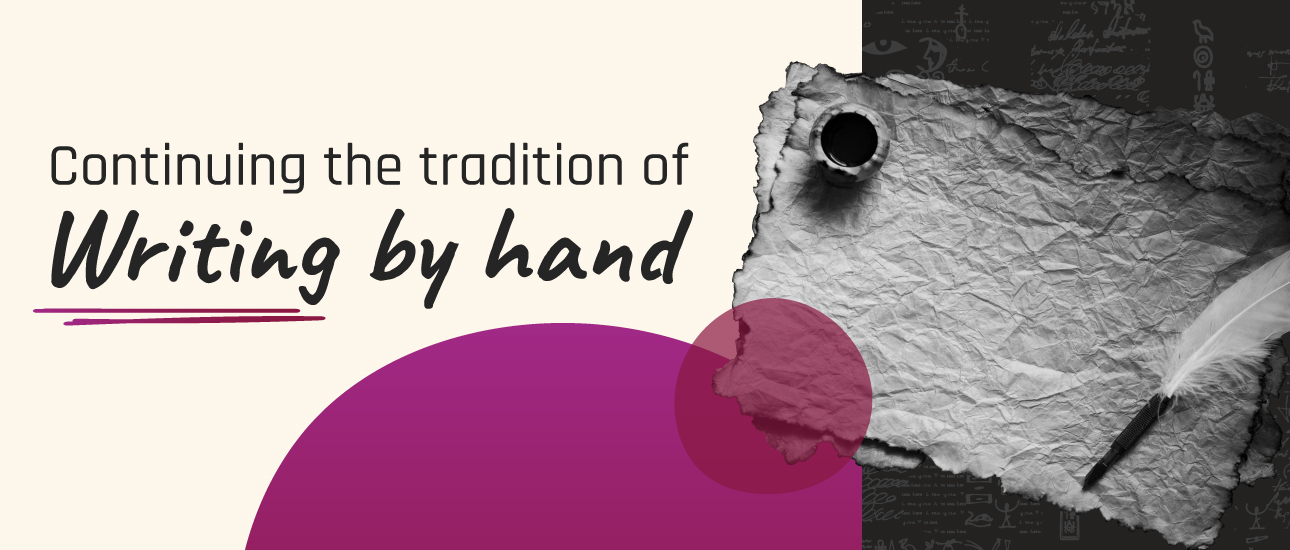
In today’s world, thanks to the internet, typing, texting, email, and online documents are more common that handwriting. However, handwriting will always have its special place even in the modern world. A hand-written note is always more valuable and conveys emotion and meaning more effectively. Even as technology evolves and there are many new ways to communicate, share ideas and work, ultimately, they all originate from handwritten sources like books, documents and letters. LMExams continues to promote beautiful handwriting by encouraging students to use their exam-only tablet computing device DigiTaal and their paperless exam platform to continue the tradition of writing by hand.

Reference Links

https://www.vletter.com/help/font-faq/history-of-handwriting.html

https://callistyle.in/blog/history-of-handwriting/

https://www.ignitepost.com/blog/a-brief-history-of-handwriting
Pass or fail in exams – is it important? A doctor’s viewpoint

Exams are an integral part of an education system. They are used to measure a student’s academic performance and knowledge.

However, the results of whether they have passed or failed can impact a student’s mental health very significantly. In the current education system, where they are being stringently evaluated, students are under constant pressure to perform well. They are continuously experiencing the fear of failure. Sometimes, the stress related to preparing for an exam or the pressure to achieve good grades can cause various mental health conditions such as anxiety and depression.

The days leading up to an exam are often the most stressful for students. The long hours of preparation, poor nutrition, the lack of sleep and the side-effects of sleep deprivation can all lead to mental health problems.

According to the National Mental Health Survey of India (2015-2016), the prevalence of mental health conditions among adolescents (13-17 years) is around 7.3%. According to doctors and mental health specialists, about 60% of all students have high anxiety which impairs their health and functioning.

There are various reasons for stress during exams. Let us examine them one by one.

Pressure to perform

Students feel the pressure to perform well in exams especially when the stakes are high. This is true in contexts when it is the final exam of a high school year or a competitive exam to enrol for a professional degree program or a college entrance exam or even an exam to determine eligibility for a scholarship. The pressure to succeed creates anxiety in them. This again happens at two levels. One is to clear the exam itself. And two, there is pressure to perform as well as, or better than, their peers.

Time constraints and fear of failure

Most students face pressure to complete the exam within the stipulated time. This sense of induced urgency leads to stress. Fear of failure is very real as it is seen as a reflection of a student’s intelligence or potential by teachers, parents and peers. This factor again causes stress and anxiety.

Lack of preparation and peer pressure

When a student is not adequately prepared for the exam, they feel overwhelmed and anxious. This leads to them panicking in the last minute. While peer pressure creates a competitive environment and can impact a candidate positively, the compulsion to perform better than one’s peers at times can make a candidate make mistakes and falter in the exam.

A doctor’s view to combat stress

Dr.Rishi Gautam, the assistant professor of psychiatry at the GW School of Medicine & Health Sciences in Washington, D.C, in the US, suggests that students adopt the following methods to combat stress:

  • Prepare well

If you do not understand a subject or a chapter, use extra classes, and other resources, or seek extra help from your teacher or another student who knows the subject well, to prepare better for the exam. Take practice tests and systematically study all the material that the test or exam is based on. Do not try and cram everything in one sitting. Or at the eleventh hour. Take your time and learn, and practice, every day. This way, you will cover some of your curriculum on a regular, even daily, basis.

  • Practice well

Practice writing down everything that you have learnt before an exam. Adapt this method to learn and relearn in a fashion that works for you. This will help you feel more confident. With repeated practice, your confidence level will go up. This will help with performing well in the exam. Talking to your teachers about questions that you have or asking about things that you don’t understand can also help you a great deal. Your teacher may even help you when you feel anxious by telling you what to focus on.

  • Relax before an exam

Do not try to keep learning till the last minute before an exam. Try to relax yourself by closing your eyes and sitting quietly. Take deep breaths and relax your muscles. Always imagine a positive outcome and enjoy the process of writing the exam.

  • Eat well, drink lots of water and sleep well

In order that your brain functions properly, eat well and drink plenty of water. Avoid sugary drinks and caffeinated beverages or energy drinks which will cause your blood sugar to fluctuate and increase anxiety. Your sleep is directly related to your academic performance. Ensure that you get a good night’s sleep before your exam so that you can be energetic and write well the next morning.

  • See a counselor

A mental health professional can help with psychotherapy to help you work through your thoughts, feelings and behaviours that worsen your anxiety. Seek help, and try to understand what is triggering your stress. Practice relaxation techniques like meditation and exercise regularly based on what your counsellor advises you. Ultimately, when you feel good, you sleep well. When you are rested, you always perform better.

Summary

Even after all these efforts, if you have received your exam results and have failed, do not let this outcome affect you. Failure is not fatal. If you feel low or sad, it is natural to feel those emotions. Learning to deal with failure in exams is important. Remember that everyone who has succeeded has failed at some point earlier. Failure is a lesson that we must learn from and use it to prepare well for the next attempt.

References

https://www.indiatimes.com/lifestyle/mental-health/how-to-cope-up-with-stress-during-examinations-601819.html#:~:text=For%20many%20students%2C%20the%20stakes,be%20detrimental%20to%20mental%20health.

https://www.bachelorstudies.com/articles/what-to-do-if-you-fail-your-exams-4240

Improving institutional (university) ranking by implementing paperless digital exams

There is a steep surge in the number of students enrolling for higher education in India today. Consequently, the number of educational institutions is also going up.

The higher education system in India is fragmented and complex. In an effort to build world-class infrastructure, the government is insisting on enhancement of education delivery in terms of excellence, accessibility and expansion. Importantly, there is an increased emphasis on the quality of education being provided by institutions.

NIRF and its parameters

Apart from mandatory accreditations, the government has formulated the National Institutional Ranking Framework (NIRF) to evaluate the performance of the institutions offering higher education. The methodology adopted by the NIRF is divided into five clusters and each of these clusters are assigned specific weightage. The NIRF is based on five main parameters: teaching, learning and resources (TLR), research and professional practice (RPP), graduation outcome (GO), outreach and inclusivity (OI), and perception.

Since there are a large number of educational institutions in the country, and there is lack of credible information, students rely on the NIRF ranking to determine the quality of education in colleges and universities.

In 2023, NIRF had 8,686 applications for ranking from 5,543 educational institutions. This is growth of around 20% in the number of applications and 15% in the number of institutions compared to NIRF 2022. This growth indicates the increasing awareness and acceptance of the NIRF ranking system among all key stakeholders in higher education in India.

An NIRF ranking is very important for a college or educational institution. The public considers this ranking to be a reputed one. Also, students apply to colleges based on the NIRF ranking. Achieving a high ranking is not easy for an educational institution. They have to work on different areas like the admission process, improve the quality of academic education and improve the examination and assessment processes. This is where LMExams comes in.

LMExams’ role in improving an institution’s NIRF ranking

LMExams, through their proprietary paperless digital exams, improve the student experience by making the entire process very transparent, objective and seamless. Students can log into the portal a few minutes before the exam starts. They are authenticated using biometrics. This is done through a fingerprints and retina scan. The question paper is provided automatically on the digital interface. Similarly the answers can be picked up by the evaluators for evaluation. The assessment is quick and unbiased. Teachers can provide feedback and comments which in turn helps the students improve their performance.

Impacting the student experience constructively and improving the overall examination process can help with increasing student satisfaction levels. Further, the ease of operation of administering and participating in examinations reduces stress for teachers and students alike. Importantly, this  keeps the participation and evaluation process very transparent.

Educational institutions that are keen on improving their NIRF ranking must actively consider switching over to paperless digital exams. This is a long-term process; it requires sustained effort and investment in a powerful vision. What is important is that visionary institutions should work on strategies that align with their reputation goals. They must recognize that more students will join them if they build a reputation for quality education and for a highly credible examination system. Additionally, paperless exams enhance sustainability.

For all these reasons, LMExams are an educational synergistic partner to improve their NIRF ranking.

References

https://www.nirfindia.org/Docs/Ranking%20Framework%20for%20Universities%20and%20Colleges.pdf

https://theleaflet.in/why-higher-educational-institutions-in-india-deserve-a-better-ranking-system-than-the-nirf/

https://www.indiatoday.in/education-today/featurephilia/story/how-to-improve-nirf-ranking-for-universities-and-colleges-1763504-2021-01-28

How to have better handwriting

Today’s digital age demands the use of keyboards and touchscreens and it seems that handwriting is a lost art. Handwriting is one of the earliest forms of being able to express oneself.

Your handwriting speaks volumes about you as a person and holds a special place in both personal and professional settings. Handwriting is your distinct identity. It is your personal signature style that is almost forgotten today.

In today’s world, handwriting refers to the style and technique that we use for our everyday jottings. There are various ways to improve your handwriting. Let us explore some of them.

Choosing the right pen

It is important to choose the right pen. There are no perfect one-size-fits-all choices. Each person is comfortable with a different pen. Purists love the fountain pen but many people are comfortable with a rollerball pen. A pen cannot magically transform your handwriting but it is important to choose a pen that you are comfortable holding. It must have a good grip and smooth ink flow.

Good posture

The best posture for a good handwriting is to sit with your back straight, your feet on the ground and uncrossed. Your hand and arm should be relaxed. Maintain the relaxed posture and keep the forearm on the table so that the fingers move rather than the wrist.

Choosing the right paper

Lined paper is the best for good handwriting where the lines are not too close. A thick pad can distort your handwriting so ensure that you tear a few pages from the pad and then write on them. When you write large letters, the individual alphabets are formed neatly but you can reduce the size depending on the paper that you are using.

Pay attention to grip

A relaxed grip of the pen allows free movement across the page. Gripping the pen too tightly can lead to fatigue and affect the quality of the handwriting. The muscles in your hand must not be stiff and tensed and your fingernails must not be white from squeezing the pen’s barrel. Clutching the pen will result in an aching hand and shaky handwriting. Have a natural grip that allows you to write comfortably.

Speed of writing and letter formation

Writing at an optimum pace can result in a good and neat handwriting. Slow writing enables you to form the letters well and put the right strokes. Rushed handwriting is often illegible. When you write, each letter should have the same height and slant throughout your writing. It is important to practice writing each letter to ensure that they are well formed. The clarity of individual letters affect the readability of the handwriting. If you are using cursive writing, ensure that the letters are connecting smoothly and gracefully. Ensure that letters are well spaced out and not squeezed too tightly to avoid confusion. The key to good cursive writing is to achieve a balance between connectedness and readability.

Practice

Use a handwriting worksheet to practice to improve your handwriting. The more you write, the more you can improve your handwriting. Find ways to use writing by hand instead of typing. For instance, try and leave a handwritten note instead of sending someone an email. Write a journal every night. Handwriting improves as your write more!

Conclusion

Apart from having the proper tools, it is very important to practice writing every day in order to have a good handwriting. It is also very important to embrace your own personal style of writing. Your handwriting is a reflection of your mood and style. That is why a handwritten note is more precious than a typed one – it is a piece of you! Review your handwriting regularly and identify areas of improvement. Your handwriting reflects who you are and is an important part of you.

References

https://www.theguardian.com/lifeandstyle/2014/may/11/how-improve-your-handwriting

https://thepostmansknock.com/8-tips-improve-your-handwriting/

https://www.indiatoday.in/education-today/featurephilia/story/8-simple-tips-to-improve-your-handwriting-2410586-2023-07-24


Advantage of paperless digital exams

A few years ago, even the thought of paperless exams would be unimaginable. Today paperless exams are a reality. How did this start and how does it work? These are the questions that come to mind immediately.

LMExams, started by LittleMore Innovation labs (LMI) has a pioneering solution with a customized software that enables students to write exams, in their own handwriting, digitally.

Environmental impact

Quite obviously, the first advantage of paperless exams is the impact on the environment. Any large university or college holds exams for thousands of students and distributes question papers and answer booklets to students to write their answers. Paperless exams save an enormous amount of paper that students would otherwise have used up to write exams. The direct positive impact on the carbon footprint offers a great opportunity for institutions to be environmentally responsible. Additionally, paperless exams are liberating for students, teachers and the managements of institutions. The entire process of administering and participating in exams is made simple and seamless. They don’t have to go through the grind anymore.

Technology advantage

The technology and the software that power paperless exams helps generate timely reports of marks and grades scored by each student. These reports provide accurate details of the time taken by each student to finish the exam. The scoring of exams can be done faster using technology since examiners do not have to correct the objective type (or multiple choice) questions. Artificial intelligence tools take care of this process. This saves time for the examiners. Importantly, the technology is cutting-edge. It is completely internet-free. The process of students logging in and the answers they provide to questions in an exam can all be done without an internet connection!

The human factor

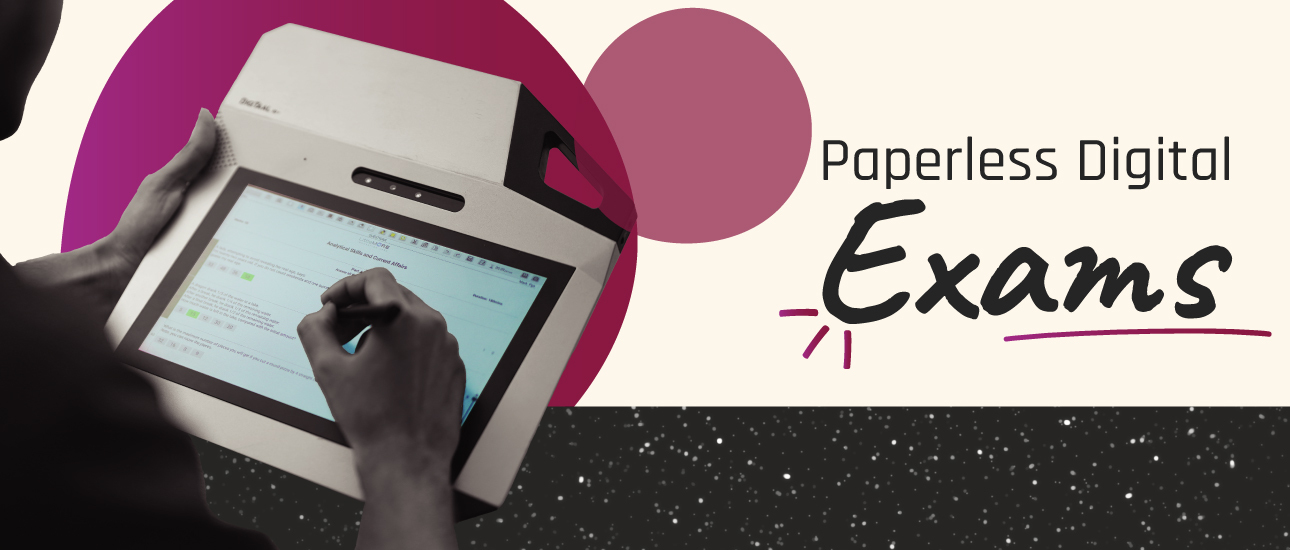
LMExams provides electronic pads called “DigiTaal” to the students before an exam. This is a substitute for paper. The special coating on the electronic pad ensures minimum strain on the eyes of the students. It also has a battery life of over 14 hours which makes it very suitable for writing exams. The device has a stylus that enables students to write answers in their own handwriting. Unlike an exam where keyboards are provided and handwriting becomes a lost art, paperless exams written the LMExams way ensure that the students are not feeling uncomfortable or any different than when writing on paper.

Secure and stable

LMExams offers very secure exam process. All aspects of the process, such as the authorization of faculty, student log-in, serving of questions and evaluation of answers are done in an extremely secure and stable manner using technology. Students can log in just before the exam and their identities are authenticated using biometrics like fingerprint and retina scan. Thus, a very secure and reliable environment is offered to the student. Students can correct their answers easily if they want to revise them during the tenure of the exam.

Summary

Paperless exams are massively advantageous to all the stakeholders concerned: students, examiners, managements of educational institutions and, to top it all, it has a big impact on the environment. Paperless exams are here to stay. As they get adopted by more and more educational institutions, they will bring about a sea change in the world of examinations.

References

https://yourstory.com/socialstory/2019/04/paperless-exams-littlemore-innovation-cloud-computing

https://onlineexammaker.com/kb/what-are-the-benefits-to-organize-a-paperless-offline-exam/

AI/ML in exams – will they take over exam administration?

Artificial intelligence (AI) and machine learning (ML) are not just technology buzzwords. They have varied benefits and application in a variety of sectors like agriculture, finance, healthcare, and now in education too. AI can help teachers with mundane tasks like taking attendance, grading assignments, analyzing the performance of students and giving the teacher feedback about this. AI can also help transform the way exams are conducted and make them more secure and simpler to organize.

AI-based exams

AI-based exams (also known as AI-proctored tests) eliminate the need for onsite invigilators and can ensure a cheating-free environment. A proctor is a person who is certified to oversee the examination process. A remote proctor can oversee the exam from any location. Remote proctoring has made online exams very secure. When the exam begins, the audio and video feed of the student is sent to a proctor who will govern the exam. Voice and facial recognition technologies which are powered by AI can moderate exams without the need for human intervention.

Online marking and assessment

The onscreen marking system uses technology and has simplified the online marking process. All physical answer sheets are scanned and uploaded to the digital system and examiners can evaluate them from any location. Some online grading software can even read the handwriting of a student, understand it and grade it as well as a teacher does! Should the AI-powered tool make a mistake, the teachers can correct it and thanks to machine learning, the system will not make the same mistake again. These tools are 90% faster than humans and so exam results can be published immediately after an exam.

There are several advantages of using AI for grading answer sheets. One of them is improved efficiency and accuracy in grading exams. AI algorithms evaluate a large number of exam answers accurately and quickly, thereby reducing the time taken to grade exams. Another advantage is their objectivity and fairness in grading an answer sheet. They also reduce the possibility of a human error. AI is capable of detailed feedback on individual exam answers and provide detailed notes on the strengths and weaknesses of students, while also offering suggestions for improvement. This can help students understand their performance and improve their skills. Overall, there are several advantages of using AI in evaluating exam answers.

Minimize fraud and cheating

AI and ML are playing a huge role in enhancing the security in exams and reducing online cheating. AI and ML use facial and voice recognition technologies to do this. Individuals are authenticated using AI algorithms and ML based on their facial features. This way, the identity of the student can be confirmed before they begin an online exam. This prevents impersonation and other forms of cheating. Voice recognition systems authenticate individuals based on their voice. This can be used to monitor students for cheating and detect if a student is receiving assistance from anyone else or using unauthorized materials during an exam. Plagiarism detectors can help detect copying while webcams can monitor exam locations for any malpractices.

Summary

One of the benefits of using AI and ML technology in conducting exams is that they are high on security and weed out malpractices like cheating and impersonation. Conventional exams depend a lot on manual coordination and supervision. It is often a dreary and tedious process. Technology can be an alternative that not just saves time but is also hugely foolproof and efficient. AI and ML are here to stay in the space of exam administration. In the coming years, they will almost eliminate the need for human intervention in exams.

References

https://blog.mettl.com/ai-based-exams/

https://www.eklavvya.com/blog/online-exams-artificial-intelligence-ai/#How_AI_is_bettering_online_exams

https://www.merittrac.com/blog/4-ways-ai-can-help-scale-exams-and-enhance-learning-outcomes

Climate change, sustainability and LMExams

LittleMore Innovation Labs (which owns LMExams) has developed a customized software called Paperless Examinations Advantage (PEXA). This software  allows students to write exams digitally using an electronic pad (E-pad) and a stylus, instead of using paper, paving the way for a greener environment.

Consider this: If 36 exams were held for about 8,000 students every year in a university, and should the university distribute a 20-page answer-sheet booklet to every student for every exam, this really means the university has ended up using 57,60,000 sheets of paper!! This also means that the university impacted the environment negatively.

LMExams helps educational institutions save massive amounts of paper that they would have otherwise consumed in conducting an examination. So LMExams helps institutions have a lower carbon footprint!

Promoting eco-conscious behavior

LMExams not only enables saving of paper but also makes the students eco-conscious and contribute to a sustainable ecosystem. LMExams has helped organise 1.5 million exams, saving 20 million sheets of paper by partnering with educational institutions like Manipal University in Udupi, International Institute of Information Technology, National Institute of Mental Health and Neurosciences, and the Reva University in Bengaluru.

Why this eco-consciousness?

The forest cover in India has declined by 29,000 sq. km over a span 30 years, according to a report published by e-Green Watch, an initiative launched under the Ministry of Environment, Forest, and Climate Change. The loss of greenery has led to increasing levels of carbon dioxide in the atmosphere. Numbers from the World Bank say that from 1960 to 2014, the emission of carbon dioxide in India has grown from 0.3 to 1.7 metric tonnes per capita. This is affecting daily life and giving rise to serious ramifications when it comes to climate change and global warming.

Forest land has been converted into industrial spaces to manufacture commodities like paper, palm oil, fabrics and wood.  Paper mills use wood as a primary raw material. Pulp and paper production have devastating effects on ecological places and various species. 14% of deforestation is done to support the manufacture of paper goods. Our obsession with paper amounts to the destruction of around 4.1 million hectares of forest each year – now, that’s equal to destroying forest cover in an area the size of the Netherlands every 365 days.

A majority of the world’s biodiversity depends on forests. Deforestation can wipe out this incredible richness within a matter of moments. According to the WWF’s recent Living Planet report, the current levels of deforestation make the species living in our rainforests some of the most endangered in the world. Therefore, responsible, eco-conscious behavior, is the need of the hour.

A powerful case story

Manipal Academy of Higher Education (MAHE) offers 277 academic programmes in the disciplines of health sciences, science, technology and management, humanities, liberal arts, and social sciences. They operate from five campuses. About 29,150 students are enrolled in these programmes. Imagine if MAHE had not used LMExams’ digital paperless exams and instead had answer sheets been used to conduct exams for these students! By using LMExams, MAHE were able to save around 1.4 crore paper sheets, which would have saved around 500 trees, as per the estimates provided by the non-profit organization ‘Conservatree’.

Summary

Historically, paper has been a medium to transfer knowledge and capture information for many years by humankind. It has also been used to archive information and store it for ready reference through the use of books and notebooks. Over the years, the system of digital storage has taken over and it has its own advantages in the form of being secure. A paper can tear, burn or get stained with liquids like coffee. The biggest advantage is that digital devices can save massive amounts of paper resulting in a huge impact on the environment. LMExams is a pioneer in this space and is leading the way to save the environment and impact climate change.

References

https://paperontherocks.com/2018/11/28/environmental-impact-of-deforestation/

https://yourstory.com/socialstory/2019/04/paperless-exams-littlemore-innovation-cloud-computing

https://uniwise.eu/blog/dqtb8ajbhg69gwj8bvf3mbx70zdoqt

Download Brochure